
Belt Speed Calculator for 2x72 Belt Grinders - sfpm calculator
The heat treater that I use has a lot charge of $150. If I want a case on the end of a punch that is 0.75" dia., I can do that with my acetylene torch for about $5 of material and 10 minutes of time. I like those numbers.
Years ago, there were compounds to do this that had cyanide in the mix. You sure don’t want that. Cherry Red has no cyanide, but you don’t want to eat the stuff or get it in your eyes. Like every process at a metalworking shop, you have to be reasonable about safety.
2. Coat the red area with the heat-treating compound. When I do the end of a punch, I put some compound in a tin can and plunge the tool in. Use a well-ventilated area or, better yet, do it outdoors because it gives off ammonia fumes when the compound is heated. Cherry Red comes in a plastic container, so don’t put hot metal in the container. And take care because the compound can irritate skin.
D Ma · 2016 · 50 — Moreover, adding cobalt or nickel (low melting point materials) in WC also reduces the sintering temperature (1400–1500 °C in LPS method). Co is commonly used ...
Heat treatingmild steel
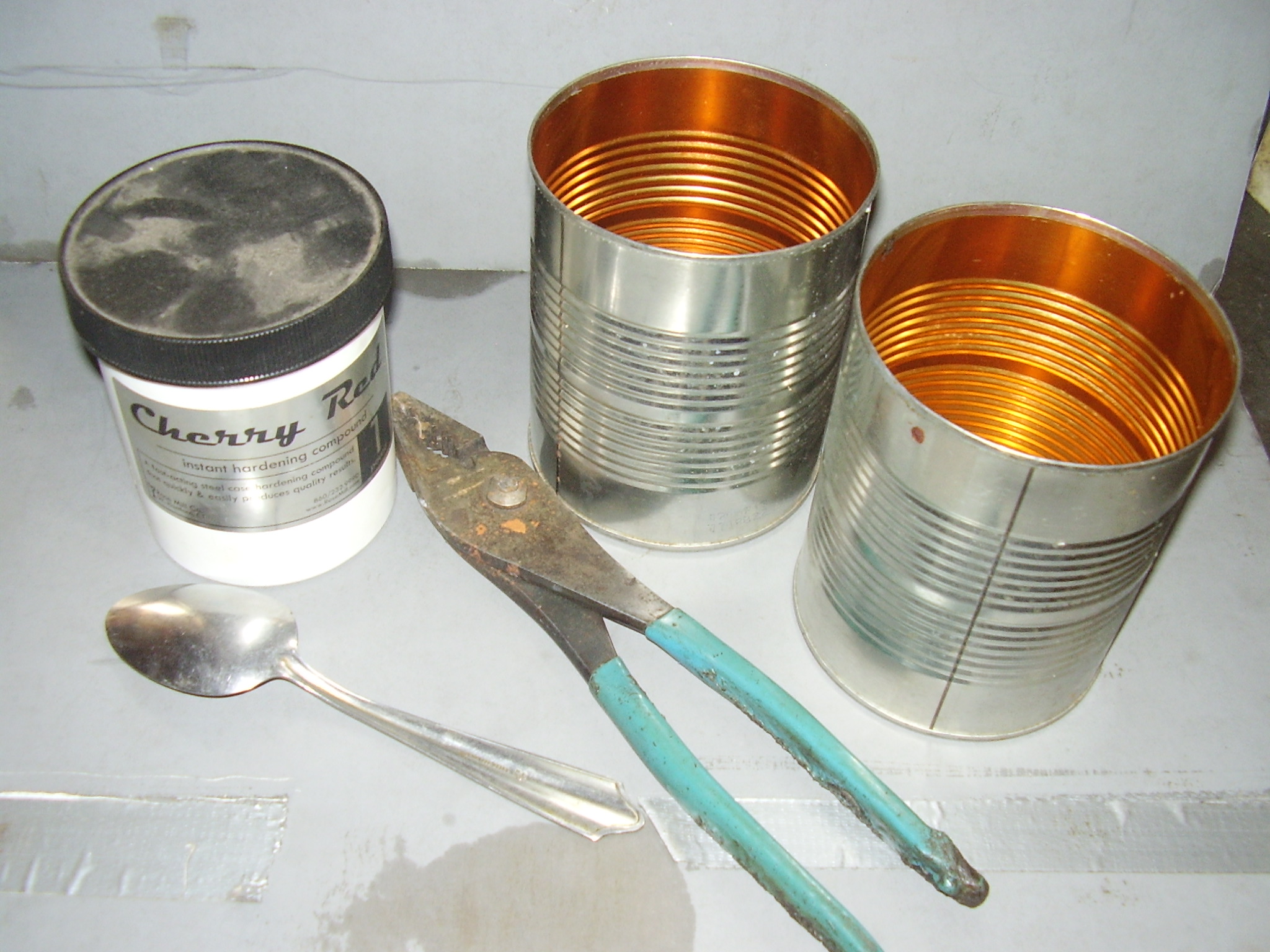
The picture on Page 10 shows what is needed: a container of Cherry Red; two tin cans — one to hold the compound and one for the quench; pliers to grab your part; and a spoon to coat the part if that’s appropriate. You also need an acetylene torch. Plan your process beforehand, and check to see that everything will work smoothly. You want the part to be bright red when coated by the hardening compound. You’ll be dealing with hot stuff, so having a plan is worthwhile.
Mild steelknife
Find company research, competitor information, contact details & financial data for HARVEY'S HARDWARE CO., INC. of Needham, MA.

Process that combines controlled heating and cooling of metals or alloys in their solid state to derive desired properties. Heat-treatment can be applied to a variety of commercially used metals, including iron, steel, aluminum and copper.
The shank is 1/4 in. Dia and the overall length is 4 in. Ball nose spiral end mills are used for smooth contouring and fine detail passes with a CNC router and ...
How to case hardensteel
Process of increasing the surface hardness of a part. It is accomplished by heating a piece of steel to a temperature within or above its critical range and then cooling (or quenching) it rapidly. In any heat-treatment operation, the rate of heating is important. Heat flows from the exterior to the interior of steel at a definite rate. If the steel is heated too quickly, the outside becomes hotter than the inside and the desired uniform structure cannot be obtained. If a piece is irregular in shape, a slow heating rate is essential to prevent warping and cracking. The heavier the section, the longer the heating time must be to achieve uniform results. Even after the correct temperature has been reached, the piece should be held at the temperature for a sufficient period of time to permit its thickest section to attain a uniform temperature. See workhardening.
Introducing... our new line of Metal Bond Diamond Tooling https://vimeo.com/795087988?embedded=true&source=video_title&owner=63065995 STREAMLINED We cut ...
We’re pleased to offer you the services of our Customer Support staff. The Team has many decades of fastener industry experience with in-depth skills ranging from metric fasteners, to mil spec fasteners, to custom, made-to-print products, and so on.
Can you case hardenmild steel
The process causes a layer of the compound to become stuck on the steel, but it is water-soluble and so not too hard to remove. The compound dissolved in water is alkali and can irritate skin, so it’s a good idea to use rubber gloves and flush with plenty of water.
Like self-drilling screws, thread-cutting screws also create their own threads as they’re drilled into a material. The major difference, however, is that these screws require a pilot hole to be drilled first. The pilot hole is slightly narrower than the dimensions of the screw, and the threads created ensure that the two materials remain fastened together. Thread-cutting screws are ideal in scenarios where the screw will never be loosened again once installed unless repairs are required.
However, if you’re unsure what type is best for your application, Monroe EFI can help. Our experienced team can help you choose the right products to fit your needs. Contact us today to learn more about our products and find the self-drilling or thread-cutting screws you need.
Can A36steelbehardened
The specific application of the screw must be carefully considered to choose the right one. For example, the type of material will determine which screws may be best suited. Similarly, the presence or absence of a pilot hole will also be an essential factor in the decision-making process.
There is a great variety of thread-cutting screw points, and the most suitable option is dependent on the material it’s being used in. For example, different thread profiles and points are used for metal than thermosets. Thread-cutting screws generally cannot be used with soft plastics, as the chips formed during the threading process fill the cutting cavity and make the screw ineffective. Thread-cutting screws are typically made from case-hardened, low-carbon steel.

I use a heat-treating company to do the work if the part requires a certain depth of the case and hardness. For example, I get parts that require a case 0.003" to 0.005" thick and 62 HRC. I would not try to do that with the Cherry Red process, but if I make a tool or die for in-house use and want a case with an HRC above 55, then I’ll use it.
Heat treat low carbonsteel
If you make steel tools like I do, sometimes a hard surface is in order. There is a way to case-harden steel that is inexpensive and quick and can be done with an acetylene torch as the heat source. It uses a powder called Cherry Red that is available from tool supply houses.
As their name suggests, self-drilling screws drill their own holes while creating the threads. Because these screws don’t require a pilot hole, they often save on installation time and don’t require a separate drill bit to create a hole for assembly. These types of screws are commonly used in the roofing industry to attach metal roofing and siding to metal stud framing. However, they are also widely used in the electrical, insulation, HVAC, and construction industries to join metal sheets, timber, and other materials. These screws are often made from case-hardened stainless steel or 410 steel to ensure the screw is harder than the material it is drilling into.
Download scientific diagram | Drill-bit geometry. (a) General geometry, (b) Point geometry, and (c) Relief and helix angles from publication: Drilling of ...
Hardness is a measure of the resistance of a material to surface indentation or abrasion. There is no absolute scale for hardness. In order to express hardness quantitatively, each type of test has its own scale, which defines hardness. Indentation hardness obtained through static methods is measured by Brinell, Rockwell, Vickers and Knoop tests. Hardness without indentation is measured by a dynamic method, known as the Scleroscope test.
2022914 — Despite this impressive history, there's just one problem with HSS drill bits: they're slow. Compared to its more modern counterpart—tungsten ...
Using the dovetail saw, carefully cut down the vertical lines and stop on the shoulder line. To cut the tails accurately, the sawcuts should be on the waste ...
There are many different screws on the market, each designed for specific purposes. In the construction industry, along with many others, screws that create their own threads are widely used. However, there are two types of screws that are often confused with each other: self-drilling and thread-cutting screws. Both screw types create their own threads and can be used with metals and plastic components, but have important differences to keep in mind.
Brandt Taylor is owner of Berlin, Massachusetts-based Taylor Engineering, a machine shop and manufacturer of lathe chuck jaws. For more information about the chuck jaws, visit www.stopjaws.com.
How to hardenmild steelwith oil
Any manufacturing process in which metal is processed or machined such that the workpiece is given a new shape. Broadly defined, the term includes processes such as design and layout, heat-treating, material handling and inspection.
Chip has been active in the Hampton Roads industrial market for over 36 years. ... Harvey Lindsay Commercial Real Estate. Peninsula Office. Harvey Lindsay ...
How to hardensteel
#Edges:1;Grade:MT7;IN-RH/LH;Insert Size:H17/17mm;Matl:Carbide ... H23 INSERT SIZE SPIRAL INDEXABLE MILL-THREAD INSERT FOR INTERNAL UN THREADING; PITCH: 7 TPI; ...
Added to titanium-carbide tooling to permit machining of hard metals at high speeds. Also used as a tool coating. See coated tools.
Miniature Threaded Shank Adapter Drills Type D. Threaded Shank Drill Bits. Quantity. Size. Part Number. Millimeter Equivalent Length Inches Decimal Equivalent ...



 18581906093