
Boring Bars for ID and OD Turning - boring bars
Explore carbide drill mill endmills, manufactured by RedLine Tools in the United States. Get free ground shipping when you spend over $100.
Conventional Milling: Less demanding on the tool. However, tool wear can still lead to increased chip re-cutting and a rougher surface finish.
Conventional Milling: More versatile for various materials, including harder materials and those prone to chipping. The pushing action helps clamp the workpiece and reduces chipping.
1-102-4025 4F SC SE TiAlN 1/4x1/4x3/4x2-1/2, Toolmex Industrial Solutions.
Conventional Milling: Less susceptible to tool deflection due to the pushing action. This makes it a good choice for machines with less rigidity.
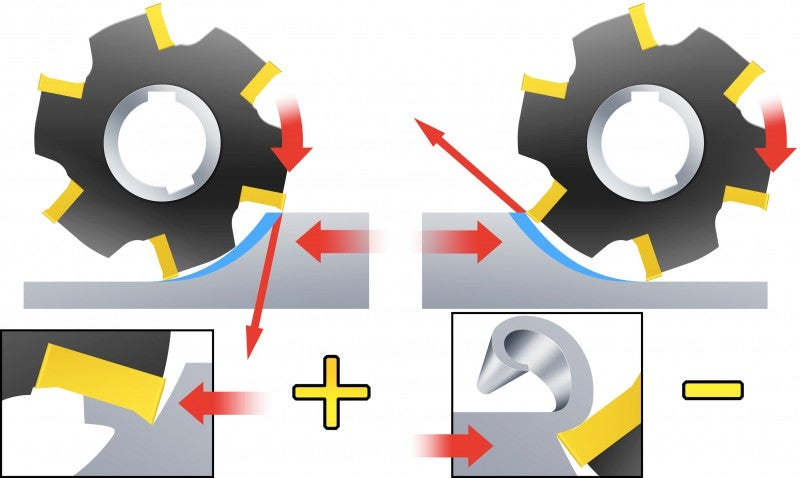
In conventional milling, the tool rotation and the feed direction are in opposite directions. This pushing action helps to clamp the workpiece down, reducing chatter and improving stability.
However, conventional milling can lead to chip re-cutting, which can cause a rougher surface finish and potentially accelerate tool wear.
In climb milling, the tool rotation and the feed direction are in the same direction. This creates a shearing action where the chips are pushed away from the cutting zone, minimizing recutting and potentially leading to a better surface finish.
Climb Milling: Excellent for finishing cuts where a superior surface finish is important. It can also be used for roughing cuts on softer materials with proper considerations for machine rigidity and tool selection.
Tolerance Calculator. Calculate the tolerances of shafts and holes ... g6, g7, g8, g9, g10, js1, js2, js3, js4, js5, js6, js7, js8, js9, js10, js11 ...
Made from Solid Micro-grain Carbide, Tapered Neck and fillet radius provides maximum rigidity, All shanks have a lockdown flat for faster setups. These are made ...
Climb (Down) milling and conventional (up) milling, the two main approches of metal removal with rotating tools. While both achieve precise cuts, the direction of the feed (movement of the workpiece) relative to the tool's rotation creates distinct advantages and disadvantages.
Conventional Milling: Ideal for roughing cuts where a smooth finish is less critical and chip evacuation is important. It's also preferred for workpieces prone to vibration or chatter due to its improved stability.
By understanding these factors and carefully considering your project's needs, you can select the right milling technique for optimal results.
Climb Milling: Ideal for softer, ductile materials where a smooth finish is crucial. It's less suitable for brittle materials prone to chipping due to the pulling force.
Conventional milling, on the other hand, provides better stability, handles a wider range of materials, and is less prone to deflection, but may result in a rougher surface.
2024618 — Climb milling involves the cutting tool rotating in the same direction as the workpiece feed. The chip thickness decreases from the start of the cut, gradually ...
Unionfab provides a comprehensive range of CNC machining services, including CNC Turning, CNC Milling and CNC Routing. With multi-axis milling and turning expertise, we can deliver custom solutions.
. Please enter the desired qty for the material(s) you want to include in your promotion or Proceed Without Promotion and only your base materials will be added to the cart.
Climb milling and conventional milling offer distinct advantages and disadvantages. Climb milling excels in achieving a superior surface finish and requires less cutting force, but demands a rigid setup and stronger tools.
However, climb milling can put a greater strain on the tool due to the pulling force exerted by the rotating tool. This can lead to tool deflection and affect dimensional accuracy.
Tolerance centre: - mm. Tolerance of hole. Tolerance zones for internal dimensions. Please select, H1, H2, H3, H4, H5, H6, H7, H8, H9, H10, H11, H12, H13, H14 ...
performance precision,cnc machining,welding,custom fabrication and manufacturing.
Climb Milling: Requires a rigid machine setup to minimize tool deflection. This is especially important for deep cuts or weak tools.
To choose the right milling technique for your project, it's necessary to learn about pros and cons of climb and conventional milling.
Discover the differences between climb milling and conventional milling techniques and learn how to optimize your machining processes.
Climb Milling: Puts greater strain on the tool due to the pulling force. Sharper and stronger tools are recommended to minimize deflection.
In Chapter 8 (on side rake), St. Clair advocates positive side rake of 10-20 degrees for most materials. Negative side rake is suggested for chilled cast iron.
WIDIA face milling products provide productivity in milling alloyed steel to ... How Do Catalogue Numbers Work? C. N. M. G. 12. Insert Shape. Insert ...
Our services cater to diverse client applications, ensuring accurate, efficient, and cost-effective production of your finished components.

G Krauss · 1999 · 1077 — Large amounts of retained austenite are typically present in plate martensite microstructures. The morphology of martensitic microstructures af- fects ...



 18581906093