Brass Fibula with Spiraled Ends – Lord of Battles - spiraled ends
Hopefully that’s a no-brainer for you. Even in non-performance applications, carbide will exceed high speed steel in value for both cost of tool over service life and in surface finish.
The other factor is binder ratio. For carbide cutting tools, the binder is cobalt. This could have anywhere from 2%-20% cobalt content. Since cobalt is softer than the carbide grains, more cobalt means a tough tool, less cobalt means a harder tool.
Aluminum millingServices
PCD, polycrystalline diamond, quality ADC (ISO N05-N40)Polycrystalline diamond with carbide base, fine grain, good cutting edge sharpness and low cutting ...
Aluminum is an absolute staple in pretty well any machine shop. It’s one of the most machinable metals out there, so it can be processed quickly and efficiently.
If you want to cut aluminum better, look for end mills with high lubricity and an efficient flute design for chip evacuation.
How to millaluminumat home
Another tip is to use a cutter diameter that’s slightly smaller than the inside radius of the pocket. If you’re using a 1/2″ endmill to cut 1/4″ rad pockets, you’ll have the tendency of gouging the corners with chatter as the tool changes direction. At high speeds, tools don’t change direction instantly, which means that the tool unloads cutting pressure. This is what makes those chirping noises.
Another thing worth mentioning is tool coatings. In general, uncoated tools are the way to go. You won’t get much performance out of special coatings, and the more “standard” tool coatings will do more damage than good.
Generally speaking, anything over 10,000 RPM needs to be well balanced. You’ll find balance ratings right on your tools, so match them up accordingly.
I’ll usually ask if I can resize those rads to 0.265″ for clean corners. This reduces the contact that the tool has with the part geometry. The machine is also able to handle that rounded turn at higher speeds. Just think of a car on a race track. If it’s a sharp corner, the car slows down. If there’s a larger radius, the machine doesn’t need to slow down.
Ultimately, if you really want to excel with aluminum, you’ll need to do some experimenting of your own. Work with your tooling reps to come up with awesome solutions to improve your processes.
Ok, to be totally honest with you, I haven’t found coatings to make too much of a difference with aluminum. At least not like they do with steel. My go-to is simply a polished, bare endmill or insert. I’ll more so play around with the coatings when a salesman offers me free tools to experiment with. Insert devious chuckle here.
Aluminummachining near me
If your tool heats up, the aluminum will weld itself on to it, and it’s game over. It happens in less that a second; all you hear is spindle load skyrocket and snap!
This should go without saying, but if you bump your tools in the machine, they’re no longer balanced. Also keep in mind that the entire tool assembly needs to be balanced. If you have an ER collet chuck rated for 20k RPM, but you mount up a boring head, that collet rating means nothing.
Your CNC spins the bit at 18,000 RPM, and the bit has 2 flutes (cutting edges). To determine the feed rate: Feed Rate = 18,000 x 2 x 0.4. Therefore, your Feed ...
For most applications when milling aluminum, I’ve had the most success with old-fashioned aggression for getting good material rates. Things like peel milling is a waste of time the large majority of the time, except for when you’re working with very small cutters in cramped geometry.
If you’re interested in learning some more machining tips, here are some articles that I’d really recommend that you take a look at:
A lot of companies will tell you that coolant type makes a huge difference for things like tool life and surface finish quality. Does it?
Feed rate is where a lot of guys chicken out. If you’re feeding a 1/2″ endmill at only 0.003″ per tooth, you’re just wasting time. For production, you want to push it at least at 1% of the cutter diameter per tooth. This means that 1/2″ endmill needs to be fed at least 0.005″ per tooth. With a stable setup and short tool, you might even be able to double that.
Metric thread forming taps or chip-free taps are tools used to make threads in softer materials such as aluminum, soft steel, brass, and copper among others. Unlike cutting taps that remove materials to make the thread, thread forming taps displace the material to make the thread. Form tapping results in a stronger thread due to the compressing of the material and does not leave chips or swarf after tapping. Thread forming taps are available in various metric standard sizes and in different thread forms.
2 flutes can be a viable option where cutting forces are lower and chip clearances are more of a factor. This can also be a way to reduce cutting forces for light, iffy cuts. One area where this makes sense is when you have a very long tool that is prone to vibration. 2 flutes cut lightly, so it might help you deal with vibration.
For grain size, larger grain produces a harder material, whereas smaller grain produces a more impact-resistant, tough material. For aluminum, we want to maintain that edge sharpness, so we want a small grain size for maximum edge retention.
It’s worth noting that there is a noticeable difference between cast and wrought aluminum. Cast is always gummier, so keep your tools razor sharp and proceed with caution.
One thing that I’ve had great success with is polished tools. When the cutting flutes are polished smooth, the aluminum glides across them smoothly. Since there’s so little friction, the tool life goes through the roof and you can push them faster.
Personally I prefer stub flutes, since the tool is significantly stronger, and you don’t get any wasted motion as the tool zips back and forth. Deep slotting is one of those applications where it’s often worthwhile to use a specialized tool.
Can't find what you're looking for? Use the search function above, browse our categories and brand list, or contact us. AIMS Industrial delivers worldwide. We offer free shipping* on orders over $299 for Adelaide, Brisbane, Melbourne, Canberra, Perth and Sydney. *Terms and conditions apply.
The main problems that you’ll see is in dealing with friction and heat. In the next section we’ll go over how to deal with these problems so that you can fine-tune your process.
Forge welding is essentially the oldest way of joining two pieces of metal together. Some say that it's been around for almost 4,000 years, starting from when people were learning to smelt iron from...
I've been involved in metalworking in its various forms for the past 14 years. On this website, I share some of the really cool things that I've learned while working in all kinds of different shops.
BERG Workpiece Holding Clamping Systems ... BERG-Spanntechnik offers an extensive range of power operated chucks and hydraulic cylinders which meet all the ...
If you’re making a bracket for Farmer Joe, it’s really not going to matter how efficiently you remove material. But if you’re making 10,000 brackets a week for Hustler Joe, you need to do a proper job.
Aluminum can melt and fuse to the tool if there’s too much heat. So even though it cuts like butter, it won’t for long if the aluminum sticks to the tool and you end up doing friction stir welding instead of machining.
Ok, well that’s pretty well it. Of course, there’s a lot more to learn with cutting aluminum that will let you smoke the competition, but this is an article, not an e-book.
Beyond keeping friction to a minimum, chatter can be a beast when you’re pushing the machine. This is especially problematic when you’re trying to machine clean looking pockets.
Here’s the balance we’re trying to strike: a slighter helix angle will reduce heat since it’s cutting for less time. A higher helix is smoother cutting, gives a great surface finish, but generates more heat.
Essentially we just need to understand what we want out of a tool. Aluminum is soft cutting, meaning that the tool doesn’t undergo hard impact forces as it cuts.
For extremely deep slots, there are two options that work well for me: either use trochoidal milling to reduce cutter deflection and chatter, or use a stub flute endmill.
This is something that a lot of guys don’t do right. If you step over half the diameter of the cutter and half down, you’ll be making a mistake for two reasons:
Never cut aluminum dry. The guys that do this on YouTube are only doing it so you can see what’s going on. In real life (and behind the scenes) cutters blow up when they plug up from melted aluminum building up on the edge.
A lot of people do a climb rough cut, followed by a conventional finish cut. The deflection on the climb cut leaves a little extra material that's removed by ...
To be honest, this is usually is what’s recommended for most cutters. 1000-1500 SFM is a totally normal speed to run your spindle at. With harmonic testing, though, you can hit 3x this speed. More on that later.
It’s really worth it to do your surface finish calculations so you can determine the max feed rate for your finish cuts. I’ll usually do the math, and then back it off about 10% of that to be safe. If you straddle that edge, you’ll be wrong half the time.
These systems ain’t cheap, and you obviously need a mill that can handle this high performance. When you have this as a shop capability, though, you’ll be way ahead of the general machine shop competition.
Aside from balancing tools that won’t destroy your spindle at high RPM, harmonics testing is really an awesome advantage for machining aluminum. Since aluminum is so buttery, you can cut it at really intense speeds.
The thing to remember here is that all grades of aluminum are highly machinable. The only time that you’ll notice a difference between these grades is when you’re really pushing your machine. If you’re doing low volume production, it’s unlikely you’ll notice anything.
Not all aluminum grades have the same machinability. Some cut like a dream, others are so gummy that clogged broken tools become a nightmare. A key here is to understand what you’re working with.
This is really what separates the boys from the men in the aluminum milling arena. Aluminum can be cut at extremely high speeds, but your tools need to be able to handle it.
If you try to do this without the testing system, you’re guaranteed to explode your tools into a million sharp little pieces from the insane harmonics you get when you’re a little off.
Metric thread forming taps or chip-free taps are tools used to make threads in softer materials such as aluminum, soft steel, brass, and copper among others. Unlike cutting taps that remove materials to make the thread, thread forming taps displace the material to make the thread. Form tapping results in a stronger thread due to the compressing of the material and does not leave chips or swarf after tapping. Thread forming taps are available in various metric standard sizes and in different thread forms.
202094 — Ordinary nails for wood are usually of a soft, low-carbon or mild steel (about 0.1% carbon, the rest iron and perhaps a trace of silicon or ...
I really like using rebar for making all kinds of industrial-looking welding projects. It's also useful for things like reinforcing concrete, surprisingly. There are also a lot of different tools...
Millaluminumfinish
What’s critical is maintaining a razor sharp edge. For this reason, we would choose hardness over toughness for material characteristics.
Harmonics testing will help you find those resonant frequencies of the tools and let you work out the sweet spot speeds and feeds. If the cutting frequency is off, the tool will start to vibrate like a violin string and you’ll have every reason to go home early.
The only exception to this is when you’re working with small tools, like 1/8″ or less. Chip clearance can become an issue, which means that you’ll need to slow down for thinner chips.
Using a finishing tool that’s razor sharp, high helix, and with very aggressive rake angles will also help you out with getting a super shiny surface finish.
Using traditional parameters like full width and 1/2xD depth of cuts generally work better in real life when cutting aluminum.
The main reason for this is that the machines often can’t keep up with the extremely high accels and decels required to really take advantage of chip thinning when peel milling. You can’t have a 1,000-lb table turn on a dime at 1,200 IPM.
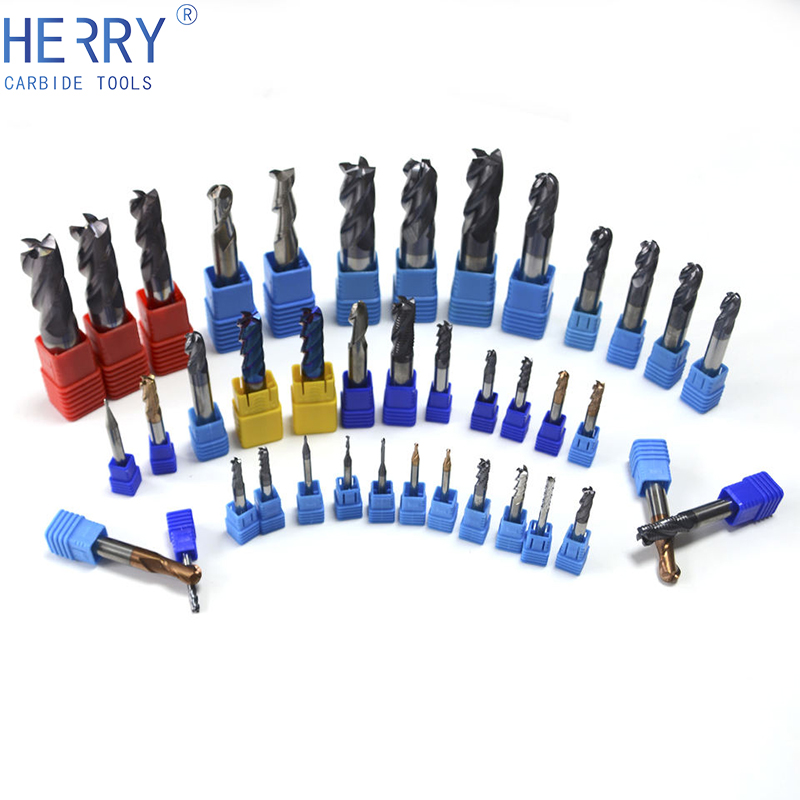
3 flutes is the sweet spot for solid carbide endmills 98% of the time. Chip clearance is the name of the game for aluminum, and 3 flutes give you that perfect balance of tool strength and chip clearance.
At the end of the day, though, 3 flutes is the industry standard. For larger tools, like shell mills, this number of flutes sweet spot will vary by diameter. The key here is to have a huge amount of chip clearance so nothing gets plugged up. Nobody wants a constipated tool at 700 IPM.
For roughing, a lower helix angle of about 35 degrees works great. This keeps the tool cool, and nobody cares about surface finish when roughing.
Lots of guys simply go with 1000 SFM to calculate their RPM. If you do this, you’re really not going any faster than everyone else.
A simple but effective jig for cutting gentle tapers on the saw bench. Made of aluminium extrusions, the jig is held against the rip fence with the work ...
At one shop where I worked, tap testing allowed us to run our 3/4″ endmills with a 10″ gauge length at around 22k RPM and 700 IPM. Sometimes we could go faster. Try and pull that off without harmonics testing. I dare you.
MillingAluminium speeds and feeds
Generally speaking, just use a 135-degree split point drill and you’ll be ok. If there’s a web on the tip of the drill, you’re putting a lot of unnecessary heat in the cut.
For finishing, a higher helix angle of 45 degrees is a total rock star. Sure it generates more heat, but for light finishing cuts at high feed rates, who cares? The smooth cutting leaves a beautiful and accurate surface finish.
Areas Of Interest (AOI) used in the analysis and their naming conventions. Each area is named after the axis and divided into three parts: top of the axis ...
If you’re going to use a shell mill, definitely go with a super aggressive rake angle and polished inserts. Your finish will be amazing and you’ll be able to really push the RPM.
This is also true when it comes to determining cutter accuracy. Lots of guys totally overlook this, but carbide endmills will actually have a shank fit rating. This can make a big difference with some kinds of toolholders, like hydraulics. A tighter, more accurate fit will mean better balance, better tool life, and a longer lasting spindle.
At the end of the day, spindle power and RPM should tend to be the main factor that’s slowing you down for aluminum roughing on most machines, for average-sized parts.
The main challenge with machining aluminum effectively is simply getting the maximum material removal rates without blowing something up.
In this article, I’ll share all you need to know to hit the ground running so that you can land some good jobs and handle them like a pro.
One thing worth mentioning though is that you don’t want to waste your time making the part prettier than it needs to be. Sometimes you’ll just want to make the customer happy and impress them, but remember that there’s a difference between shiny and a high Ra.
Carbide drills isn’t always the answer; there’s not really any point in running an expensive carbide drill if you don’t have the spindle RPM or production volume to justify it.
Special Lollipop Cutter Exporter in India - Max Milan Tooling Pvt. Ltd. is best Manufacturer & Exporter of Special Lollipop Cutter in Bangalore Karnataka, ...
Make It From Metal is owned and operated by Maverick Manufacturing Solutions. Make It From Metal is a participant in the Amazon Services LLC Associates Program, an affiliate advertising program designed to provide a means for sites to earn advertising fees by advertising and linking to Amazon.com. Make It From Metal also participates in affiliate programs with Bluehost, Clickbank, CJ, ShareASale, and other sites. Make It From Metal is compensated for referring traffic and business to these companies.
The Bar Champ is a manual bar chamfering machine used to chamfer bars for… ... Designed to mount in a CNC Lathe main spindle or sub spindle and provide…
Finding those sweet spots for tool frequency vs RPM is a big deal. This could boost your RPM from 7,000 RPM to 22,000 RPM, with the feed rates to match.
I've been working in manufacturing and repair for the past 14 years. My specialty is machining. I've managed a machine shop with multiaxis CNC machines for aerospace and medical prototyping and contract manufacturing. I also have done a lot of welding/fabrication, along with special processes. Now I run a consulting company to help others solve manufacturing problems.
Aluminum millingmachine
Of course, some machines are just old and tired, and there’s too much backlash to cut any faster. Really, though, you’re not going to be competitive on these machines anyway.
Under no circumstances should you ever use a general-purpose cutter for aluminum. Technically it’ll work, but aluminum is totally different from steel.
That’s also why it’s tough. Since everyone is cutting it, machining aluminum is a really competitive space. This is especially true of production machining.
General-purpose taps technically work, but taps specifically for aluminum are significantly more reliable. They have a much more aggressive rake angle, which means cleaner cuts and less heat.



 18581906093