Brick Tactical Stahlhelm Helmet gunmetal - tactical brick
Block spindles are flat-mounted units with bearings in the block itself, giving you a higher rigidity though a slower shifting of tools. Block gear spindles need to have the entire unit removed to switch spindles, and will need a tram when installed.
We engineer each and every machine tool spindle to achieve the maximum possible rigidity, while meeting or exceeding the speed capability required for the application. Wherever you see a CNC spindle or specialty spindle carrying an RAS tag, rest assured that you get the absolute best performance in quality and reliability.
I have a question I come across frequently, regarding the situation of cutting a slot-shaped pocket that’s, say, 1.5x the cutter diameter in width. The FIRST cut at each level is going to essentially be a full-slot, 100% width of cut. The next cut, however will be a thin-ish cut under 50%.
Milling spindles: Can support a wide range of cutting features into moldings and millwork, with some options for other machining tool operations
Quick Change Tool Posts, Replacement Parts, Tool Post WORMS, Turning Holders & Socket Screw T Wrenches, Universal Lathe- Spindle and Collet Stops, Universal ...
Now suppose you have an older machine with 0.020″ of backlash and are running an 0.005″ chip load. If the worst happens there your chip load will soar to 0.025″, which is probably going to break the endmill and is very dangerous.
First station indicates shape of insert. · Second station shows relief angle or rake angle of the insert. · The third station provides a working gage for ...
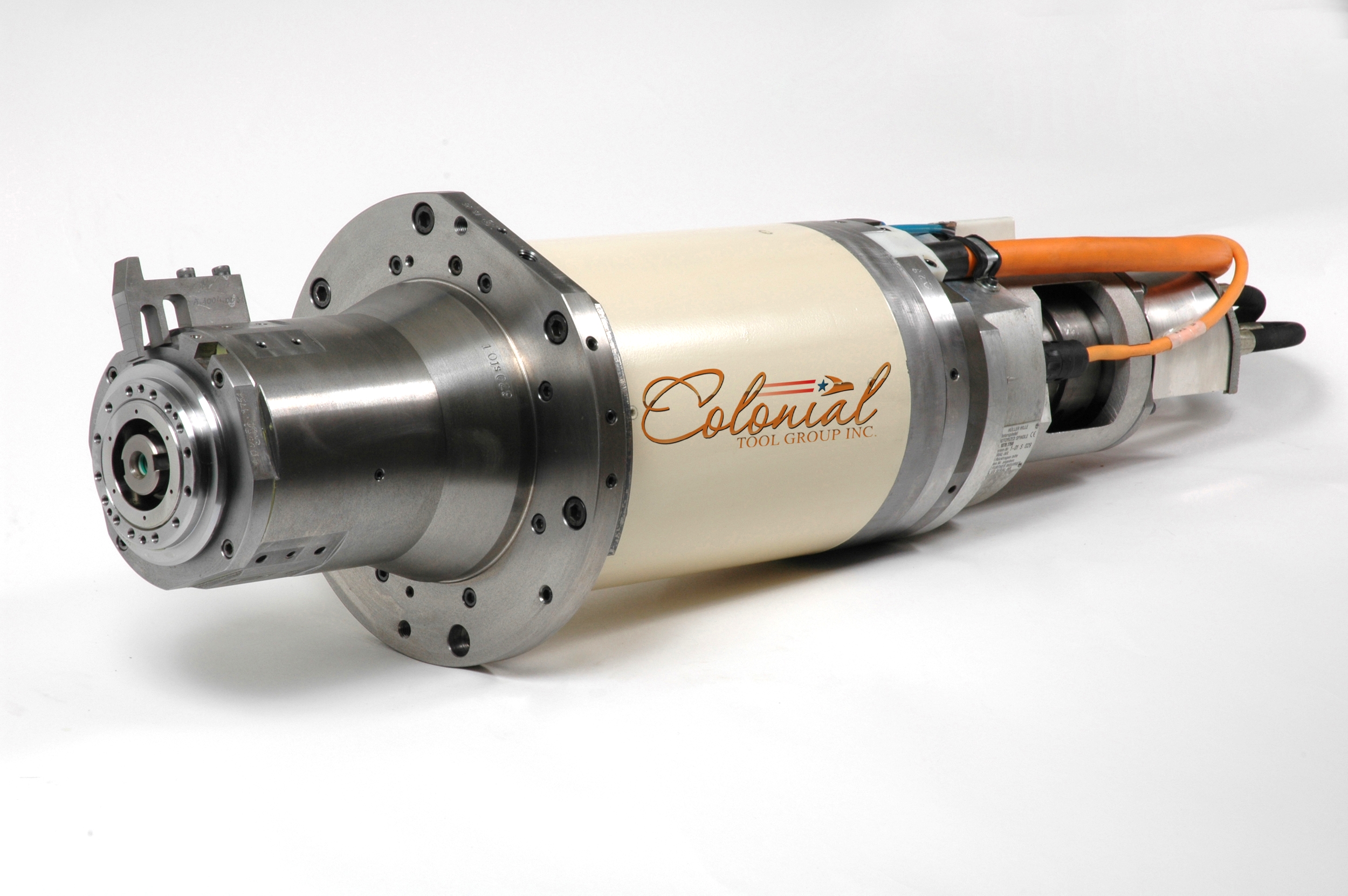
With over 330,000 motorized spindles built, two manufacturing plants and customers in four continents, Colonial is capable and ready to handle any spindle project small or large.
You can therefore add the backlash to the chip load to see what your new effective chip load might be in this worst case. Suppose you are roughing 0.005″ per tooth and have 0.003″ backlash. In the worst case, your chip load will soar to 0.008″. That’s probably not the end of the world, but it is a strain.
The alternative is for the cutter to plow deeper into the wall or pull away from the wall. Either case will introduce more error in the part being machined. The counterpoint is that the lengths of the vectors are longer when conventional milling. That’s telling you that the cutting forces are heavier and the tool is more likely to deflect with conventional milling.
The problem is that deflection affects surface finish too. If the vector is nearly parallel to the path, you can consider that the portion of the vector that pushes it “off parallel” is very small. Therefore, the tool will have little tendency to deflect and put waves on the wall you’re finishing. Note that this may be particularly important with thin walls work where the walls are weak!
The arrows show where the cutting force is attempting to deflect the cutter. Conventional cut at top, climb cutting at bottom.
I would continue to Climb Mill a Chamfer Mill or Roundover Mill because they can be a bit chattery and the reduction in cutting force helps minimize that.
Milling machine spindleassembly
Air-driven spindles provide some of the longest spindle lives and are easy to cool through both air and oil-mist options, which works for most industrial settings.

Therefore, you should switch to conventional milling for the finish pass if you’re at all deflection challenged (use G-Wizard to see if your tool diameter and stickout result in small enough deflection for your finish pass). At the very least, one should avoid too much depth of cut when climb milling to create less tool deflection.
That thick-to-thin + carrying the heat away is particularly crucial for tough work-hardening materials like stainless. It also results in a nicer surface finish if you can afford to climb for the finish pass.
The thousands and thousands of machine tool spindles we’ve built over the years have ended up in almost every feasible application scenario. Understanding the common usage may also help you select the proper machine spindle for your operations, such as the needs or benefits for gear-driven spindles, belt-driven spindles and cluster spindles.
How does climb vs conventional milling affect tool deflection and accuracy?. The following illustration contains small arrows (often called vectors) showing the direction of tool deflection and cutter forces as the cutter moves along the toolpath:
Machine spindles can be created to include automatic-balancing or air-purging options. We can also implement high-frequency drives, which use liquid-cooling to regulate heat functionally, or you can select spindles that use coolant feeds.
Chamfer cutter · chamfer cutter with reversible blades S8 HW 45° D27 12x12 KL · chamfer cutter S8 HW 30° D25-KL OFK · chamfer cutter S8 HW 45° D26-KL OFK.
Down Milling or Climb Milling is the preferred process to maximize tool life. The exception to this rule would be in work hardening materials which are more prone to chipping with climb milling.
You can also maintain a running log of information to keep efficiency high. Spindles can be equipped with encoders and resolvers to provide details about position and speed.
The traditional approach is that CNC’ers are always Climb Milling and Manual Machinists are always Conventional Milling. It’s probably true that Manual Machinists should stick to Conventional Milling as their milling style because the backlash of their machines makes it dangerous to Climb Mill.
If you have any doubts or questions, don’t hesitate to contact us. Our sales department will gladly answer your questions. You can also call us toll-free at (866)-611-5119 to learn more about pricing options, machine spindle manufacturing capabilities and support or repairs for your OEM equipment.
2023624 — We recently had to get some helical tools to replace data flute tools, since data flute couldn't get a new batch to us for weeks. He's still ...
It seems that Dapra corporation first discussed this phenomenon way back in 1971. G-Wizard now reminds you with a little hint which one you should prefer:
You’ll often hear about cartridge spindles that use a cylindrical design for the best mounting as a boring spindle. Cartridges allow for easy transition and changing of machine spindles to minimize the downtime required to shift operations. Typically, they can work with almost any motorized spindles.
Motorizedspindle
It’s a bit of a tradeoff whether the reduced cutting forces (and hence reduced deflection) of Climb Milling benefit Tool Life more than the direction of deflection for Conventional Milling, but the latter wins out. Check out our Micromachining page for more information on this cutting process.
The second thing to consider is whether cutting forces are strong enough to pull the table through the backlash in the first place. A lot will depend on the exact cutting scenario together with your machine.
One way to think of it is to consider the concept of chip load. This is a measure of how much material each tooth of the endmill is trying to cut. Typical values for finish work would be 0.001 to 0.002″ per tooth. For roughing work, that might increase to 0.005″. Now in the worst case, climb milling may grab the table and slam the work into the cutting tool by the full amount of backlash during the instant when a single tooth is cutting.
For this reason, many shops simply prohibit climb milling at all on any manual machines that have backlash. They always use the conventional milling process as the necessary milling style. Some modern machines even came equipped with a “backlash eliminator” whose primary purpose was to enable climb milling and its attendant advantages.
Colonial Tool manufactures, repairs, and rebuilds all types of CNC Machines Spindles. Their custom-build house with engineering and manufacturing of all CNC Machine Tool Spindles. We offer 24/7 fast and reliable turnaround with our expert technicians to minimize downtime you can rest assume Colonial Tool has over 96 years of experience repairing and building spindles.
COASTAL AIRBNB SERVICES - Home Cleaning. Be first to review. 49 Harvey St, Anglesea VIC 3230. 0491 180 048 Call.
Wondering whether to Climb Mill or Conventional Mill? Or perhaps wondering what each one is and what it does? You’re in the right place!
With expertise and state-of-the-art technology, our robust staff of spindle machine engineers, assemblers and other professionals will do what they can find the best solutions for your needs. It all begins with a consultation, where we'll discuss your desired applications and speak about your requirements in detail. From carpentry to military purposes, we're confident we can assist you.
We can manufacture spindles to suit a wide range of different machines, including lathes, millers, drillers and grinders. Understanding the output you need from your machines will go a long way in determining the specifications, including operating speed, input voltage, power, maximum torque, size and angle flexibility.
Spindle machines are far from one-size-fits-all devices, as you can separate them into a few broad categories — like belt-driven, air-driven and electric — and specialize their components to meet the necessary workload.
Applications · Parting / cut-off inserts that don't require screws, springs and clamps. · Ideal for parting and grooving applications. · Insert geometry designed ...
Absolutely correct, it’s definitely case by case. I had a difficult time removing wavy walls while side cutting with a long endmill. The solution was conventional cutting. Like most Machinist, climb was my go to and I tried everything from clean up passes, depth cutting, feed and speeds…. Conventional cutting was the last thing I tried. The cuts are beautiful and consistent now. Great article!
Milling machine spindletypes
There are ways to calculate the cutting tool force, but in general, smaller end mills, less depth of cut, lower feeds, and lower spindle speed will all reduce the cutting force and make it less likely the cutting tool can drag the backlash out of your table and create a problem.
We are a custom-build house with engineering and complete manufacturing of all machine tool spindles, CNC spindles and more. We offer 24-hour service with fast and reliable turnaround to minimize downtime.
Electric spindles represent the latest innovations, bringing the highest speeds, angle flexibility, power output and optimal use of torque.
But, CNC’ers should know that there are times when the climb milling process is the preferred way and there are times where the conventional milling process works better. Before we get into when to use each, let’s have a quick definition of the differences in each cutting process.
We accommodate a vast array of mounting interfaces as well for optimum fits. You can select from a few of the following examples, including:
Try the experiment on your milling machine of cutting with both millng methods and you’ll see that climb milling is a lot smoother and produces a better surface finish (most of the time, there are times when conventional milling gives a better finish, see below) than conventional milling. Note that depending on which way you are milling, you will need to make sure your workpiece is supported well in that direction.
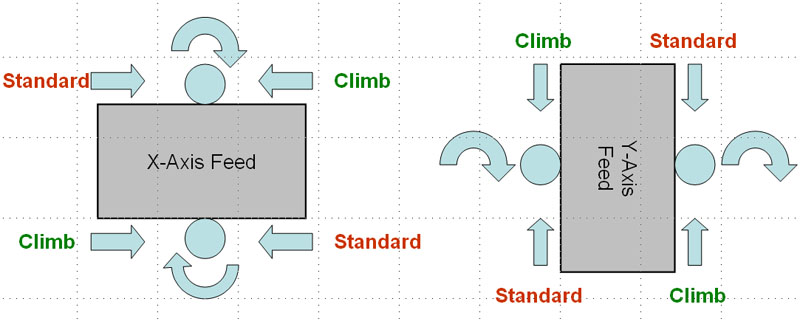
Keep in mind that for this illustration, it is the workpiece that moves, not the spindle. On some machines, like a gantry router, the spindle moves, so the labels would reverse. I keep it straight by thinking of the spindle as a pinch roller that can either help move the workpiece in the direction it was already going (climb milling), or that might fight that movement (standard or conventional milling).
You can also contact Colonial directly to get fast answers to your questions, or a smart quote on your custom spindle development.
– When cutting half the cutter diameter or less, you should definitely use climb milling (assuming your machine has low or no backlash and it is safe to do so!).
Join 100,000+ CNC'ers! Get our latest blog posts delivered straight to your email inbox once a week for free. Plus, we’ll give you access to some great CNC reference materials including:
DIYmilling spindle
Colonial Tool manufactures, repairs and rebuilds all types of Machine Tool Spindles: CNC Machine Spindles, Motorized Spindles, Multi Drill and Tap Head, Box and Cartridge spindles, Gear Driven Spindles, Belt Driven Spindles, Cluster Spindles, and any Specialty Spindles.
Our operations have been around since before computerized numerical control (CNC) machinery, providing us with a historical look at machine tool spindles from their birth. Automated machining allows companies like yours to perform drilling, deburring, milling, slotting and much more through the use of specialty machine and boring spindles.
If you’ve got a fancy low friction linear way machine, it can grab easily. If you’ve got a lot of iron in the table, and maybe you’re running with the gibs tightened a bit, it’ll be harder.
First thing to note is terminology. Some will say “Climb Milling vs Conventional Milling” while others say “Down Milling vs Up Milling”. They’re one and the same cutting process:
Over 85 years as a leading machine spindle manufacturer, RAS has stayed at the forefront of spindle technology. Engineered solutions optimized for all performance elements, coupled with customized proprietary designs, ensure world-class results.
2019715 — Titanium laser cutting can be beneficial, as titanium is as strong as steel, but much lighter, and is flexible to cut with a laser, ...
Another possibility is to go through the whole cutting process using a Climb Cut, and then do a final “ghost pass” or “spring pass” that uses the same depth of cut as the final climb cut finish pass, but is run as a Conventional Cut. Any material removed during this spring pass machining will be as a result of the tool deflection of the Climb Cut pass.
Colonial Tool engineering experts have helped push molds and dies smaller to create more precise machined parts, plus build boring and gear spindles with the high rotational speed needed to drive more advanced cutting tools. With satisfied customers across the continent, we’ve become a leader in the development, supply and manufacturing of machine tool spindles for nearly every industrial setting. See for yourself why Colonial Tool is the industry leader when it comes to spindle machines!
The toolpath generators in the CAM software I’m using don’t allow me to say “start with climb then complete the walls with conventional” (or whatever’s appropriate) in a single roughing toolpath.
The same article suggests that when deflection is to be minimized, use no more than 30% of the diameter of the cutter for conventional milling and 5% for climb milling. Of course here again, if you have G-Wizard, you’ll know what kind of deflection to expect and whether it’s a worry.
Manufacturing excellence, combined with total capability, including metallurgical expertise with in-house heat treatment, enables application-specific materials use and treatments. Ultra-precise tolerances are routinely held, using state-of-the-art inspection equipment.
Since 1921, Colonial Tool has produced hundreds of thousands of spindles. We’ve become a go-to machine spindle manufacturer for companies in Windsor, Guelph, Stratford, Detroit, and throughout Ontario and Michigan. We are also the leading spindle manufacturer for various industries including aerospace, military, and automotive
A spindle machines primary function is to hold and rotate cutting tools for various machining applications. We develop motorized spindles to meet a wide range of spindle tooling needs and meet different performance standards. Typically, spindles, both standard and specialty spindles, can be grouped into three broad categories that can guide purchasing decisions for businesses like yours:
Milling spindlehead
Custom and standard spindle tooling applications such as cluster spindles that rely on belt-driven motors are also available.
Proper coverage may not be approved. Insurance companies are paying for the damages. They are also inspecting the damages. Often times, small patch repairs or ...
Try climb for roughing, because you can rough faster and the tool deflection effects on accuracy don’t matter–the finish pass will deliver the accuracy. You can rough faster because cutting forces are lighter and the thick-to-thin chip profile carries the heat away on the chip.
CNCSpindle
After we sort out the information and lay out the groundwork for a plan, we can move on to machining and manufacturing the different parts as needed.
Bob is responsible for the development and implementation of the popular G-Wizard CNC Software. Bob is also the founder of CNCCookbook, the largest CNC-related blog on the Internet.
There is a problem with the climb milling process, which is that it can get into trouble with backlash if cutting tool forces are great enough. The issue is that the table will tend to be pulled into the cutting tool when climb milling. If there is any backlash, this allows leeway for the pulling, in the amount of the backlash. If there is enough backlash, and the cutting tool is operating at capacity, this can lead to breakage and potentially injury due to flying shrapnel.
Colonial Tool Group has stood at the forefront of machine spindle manufacturers for nearly a century, which gives us a long and proven history with creating quality products for clients of all kinds.
If you’ve never played with our G-Wizard Speeds and Feeds software, take a moment right now to sign up for the 30-day trial.
Climb milling is when the direction of cut and the way the cutting tool rotates combine to try to “suck” the mill up over (hence it’s called “climb” milling) or away from the work. Here is a diagram showing conventional and climb milling for a number of orientations:
Apr 28, 2023 — Just like drill bits, a metal reamer also has cutting edges (often helical), but only on the sides. Reaming is also a hole-making process, but ...
Some of our spindle customers are Ford, GM, Chrysler, CAT, Cummins, MAG, Comau, Ingersoll Production Equipment, Linamar, Red Viking, Raven Engineering, Cell Con, large and small machine houses and die shops. These manufacturers require incredibly precise spindle tooling, and have trusted Colonial Tool to provide it to them for many years.
One of the biggest reasons climb milling gives better finish is that chips are dropped behind the cutter, resulting in less chip recutting. With conventional milling, the chips drop in front of the cutter, which maximizes chip recutting. Second, cutting forces are reduced which can mean less tool deflection and therefore less undulation in the wall of the cut. However, in cases where tool deflection is significant, conventional milling can give a better finish than climb milling.
Note how the deflection force vector is more nearly parallel to the cut with conventional milling (albeit the arrows are longer, showing there are higher cutting forces). With climb milling, the arrow is nearly perpendicular to the cut. If your cutter deflects 0.001″, wouldn’t you prefer it to be nearly in the direction of travel?
So what’s the preferred method? The fact that it gives much longer tool life so much is almost reason enough to stick to the climb milling process. But do consider the other advantages and disadvantages as there are cases where Conventional Milling wins big
This one is counterintuitive for a lot of machinists who are trained for most of their careers that climb produces a better finish than conventional. All other things being equal, that’s true, but all other things are seldom equal!
Belt-driven spindles represent cost-effective spindle tooling solutions that will work with specialty equipment and applications. Belt-driven spindles typically provide a lower cost option.
What are the disadvantages of Climb milling? The disadvantages of climb milling are: Climb milling can cause chipping in hardened materials. While tool deflection is less likely, it will be in a direction perpendicular to the cut. So if you're getting tool deflection, the accuracy and surface finish will be worse with climb milling. Climb milling cannot be used on machines with significant backlash, which includes most manual milling machines. What are the disadvantages of Conventional milling? The disadvantages of Conventional Milling are: Tool wear may be increased as much as 50% Surface finish is worse because chips are dropped in front of the cutter forcing a lot of chip recutting. Conventional milling requires more power than climb milling. Is it better to climb mill or conventional mill? If you're doing manual machining, the backlash of the machine probably limits it to conventional machining. With CNC, climb milling is often preferred. The exceptions when it is better to conventional mill are: When milling rough or hardened surfaces. If your cut width is 3/4 of the diameter or more. Climb milling produces negative cutting geometry in these cases. When the finish pass is tool deflection-challenged, prefer conventional milling. Conventional milling is often preferred when Micromachining. Why does climb milling give better finish? One of the biggest reasons climb milling gives better finish is that chips are dropped behind the cutter, resulting in less chip recutting. With conventional milling, the chips drop in front of the cutter, which maximizes chip recutting. Second, cutting forces are reduced which can mean less tool deflection and therefore less undulation in the wall of the cut. However, in cases where tool deflection is significant, conventional milling can give a better finish than climb milling. Why climb milling is less recommended when using an old milling machine? The problem is that the old machines often have significant backlash. When climb milling, the tendency of the cut is to pull the cutter deeper into the cut. The amount the cutter can be sucked in is equal to the backlash on the machine. If there is significant backlash, you will often break the cutter. What is another name for climb milling? Climb milling is also called down milling. Which milling process is preferred for longer life of cutting tools? Down Milling or Climb Milling is the preferred process to maximize tool life. The exception to this rule would be in work hardening materials which are more prone to chipping with climb milling. What is conventional milling also known as? Conventional Milling is also known as Up Milling.
The reason is that cutter geometry forces the equivalent of negative rake cutting for those heavy 3/4 to 1x diameter cuts. This is definitely not the best for Tool Life!
Magnuson builds supercharger kits for modern muscle cars, sports cars, and trucks. Watch our video channel for comparison tests, product news, technical info, ...
Climb cut to rough and conventional to finish is in line with the consensus on cutting process over at Practical Machinist as well.
For all the same reasons, but considering deflection is much worse micro-milling, you should prefer conventional over climb milling most of the time when micro-milling. The biggest Tool Life issues when micromilling are runout and deflection.
The problem is that the old machines often have significant backlash. When climb milling, the tendency of the cut is to pull the cutter deeper into the cut. The amount the cutter can be sucked in is equal to the backlash on the machine. If there is significant backlash, you will often break the cutter.
So far, you’ve probably gotten the idea that maybe you should always be climb milling on cnc milling operations. After all, it leaves a better surface finish, requires less energy, and is less likely to deflect the cutter. Conversely, manual machinists are often taught never to run climb milling because it’s dangerous to do on a machine that has backlash. The truth is somewhere in the middle. ABTools, makers of the popular AlumaHog and ShearHog cutters, point out some worthwhile rules of thumb:



 18581906093