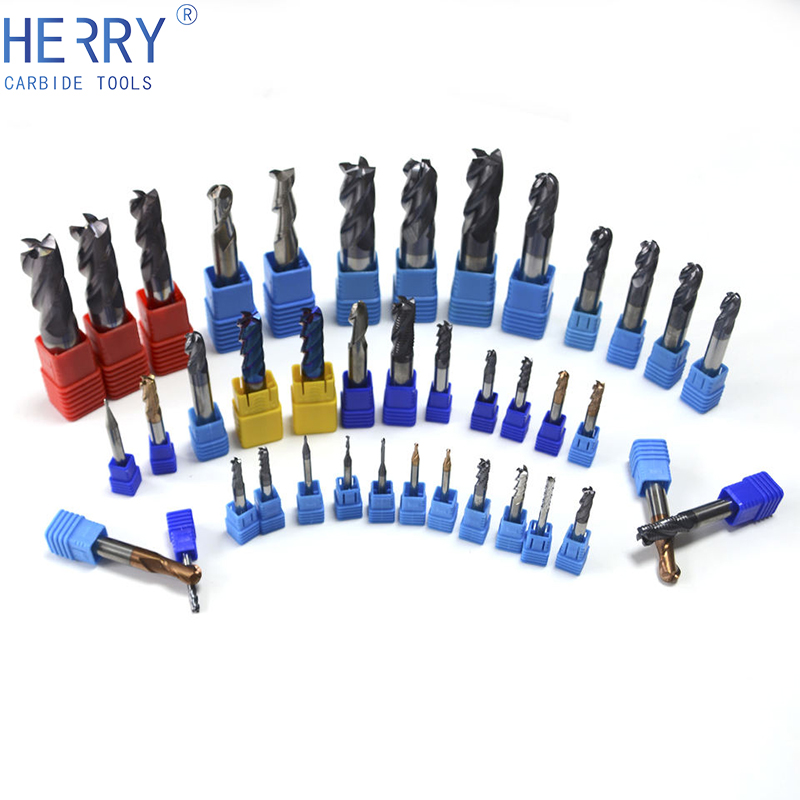
Ball Nose End mill for Sale - ball end mill
Machining recommendations, such as noted above, may require modification to fit particular circumstances in a given shop. For example, cost, storage, or requirements may make it impractical to accommodate a very large number of different cutting fluids. Savings achieved by making a change in cutting fluid may be offset by the cost of changing fluids. Likewise, it may be uneconomical to inventory cutting tools which may have only infrequent use. Also, the design of parts may limit the rate of metal removal in order to minimize distortion (of thin flanges, for example) and to corner without excessive inertia effects. An example of typical machining parameters currently used to machine Ti-6Al-4V bulkheads containing deep pockets, thin flanges, and floors at an important United States airframe manufacturer are shown in Table 6.2. A bulkhead frequently contains numerous pockets and some flanges as thin as 0.76 mm (0.030 in.). Typical example bulkhead rough forgings weigh in excess of 450 kg (1000 lb), but the finished part is less than 67.5 kg (150 lb) after machining. Extensive machining is done on gas turbine engine components, just as is done on the larger airframe components. Table 6.3 lists typical parameters for machining Ti-6Al-4V jet engine components such as fan disks, spacers, shafts, and rotating seals.
You want to select a set that includes bits that work on a variety of materials. This will allow you to use the set for a number of different projects.
However, you might be wondering if they are universal or not. After all, if you purchase a drill bit set, it may not come with instructions on whether or not those bits will work for any other project you’re working on.
Turningtitanium
The easiest and best way to do this is to read the included instructions, do your research and head to a trusted store or website to gain some expert advice. Typically, there will be a section dedicated to drilling materials and projects.
Titanium has an endurance limit of 372 MPa (54 ksi) for the gentle grinding and values of 83 and 97 MPa (12 and 14 ksi) for conventional and abusive conditions, respectively. As can be seen, in operations like end mill cutting or turning, the same sensitivity to abusive conditions was not observed, possibly due to residual surface compressive stresses.
It is also essential to consider the gauge of the bit. This refers to the thickness of the bit. The thicker the bit, the more powerful the drill will need to be.
The design of titanium alloy components often requires the use of the so-called nontraditional machining methods. Among these electrochemical machining (ECM), chemical milling (CHM), and laser beam torch (LBT) are probably the most widely used. Technical information on procedures and techniques is generally proprietary, however.
Ideally, a tool should be permitted to continue cutting as long as possible without risking damage to the tool or the work but with the retention of surface integrity. The only way to find a safe stopping point is to check a few runs by counting the pieces produced and inspecting the surface finish, dimensions, and surface integrity. In this manner it can be established how many acceptable pieces can be produced before the tool fails.
The forces in machining can be determined with a tool dynamometer. In turning, the tool dynamometer usually measures three components:
First, check the drill bits included in the set. Some bits are designed to work on a wide range of materials. Others are designed for a single purpose. Select a set that includes bits that will work on the materials you need.
For general approximations, the power requirements in turning and milling can be obtained by measuring the power input to the machine tool’s drive motor during a cutting operation and by subtracting from it the tare, or idle power. A good approximation of the horsepower required in most machining operations can be predicted from unit power requirements.
The term “machining” has broad application and refers to all types of metal removal and cutting processes. These include turning, boring, milling, drilling, reaming, tapping, both sawing and gas cutting, broaching, planing, gear hobbing, shaping, shaving, and grinding.
Titaniummachining near me
The ISO designation system for indexable inserts (ISO 1832) is a standardized system to name an indexable insert.
Another operation usable in the processing of titanium alloys is the LBT method. In this process, material is removed by focusing a laser beam and a gas stream on a workpiece. The laser energy causes localized melting, and an oxygen gas stream promotes an exothermic reaction and purges the molten material from the cut. Titanium alloys are cut at very rapid rates using a continuous wave CO2 laser with oxygen assist.

There is plenty to know about drill bit sets and whether they are universal. Read on for more details about what makes a good set stand out from the rest.
Machinists and companies specializing in the machining of aerospace materials generally will have developed techniques to maximize surface integrity of titanium alloys. Thus optimum properties usually are achieved during the production machining of titanium. In those areas of application where maximum fatigue strength is required, not only are appropriated machining parameters used, but also selected surface areas of components may be glass bead blasted to restore, or to retain, a high level of favorable compressive surface stress.
The cutting force is important since, when multiplied by the cutting velocity, it determines the power requirements in titanium machining. The thrust, or separating force, determines the accuracy produced on a part.
In down milling operation cutting tool used to rotate in the same direction to the feed of workpiece. This machining process removes the extra material from the ...

When machining titanium in circumstances in which production costs are not of paramount concern, it is still unsound practice to allow tools to run to destruction. The other extreme, premature tool changing, may result in a low number of pieces per tool grind, but the lower the tool wear, the less expensive the regrinding.
Machiningtitaniumwithout coolant
One of the practical techniques for increasing productivity is to determine the optimum cost in machining a given titanium part for a specific machining operation. If specific data are available relating tool life to speed, feed, and depth for a given operation and cutter, it is possible to calculate the overall cost and time of machining as a function of the cutting parameters. Some companies are now using computers to perform such cost analyses and to arrive at minimum costs and optimum production rates for specific machining operations.
The technology supporting the machining of titanium alloys basically is very similar to that for other alloy systems. Efficient metal machining requires access to data relating the machining parameters of a cutting tool to the work material for the given operation. The important parameters include:
Tool-life data have been developed experimentally for a wide variety of titanium alloys. A common way of representing such data is shown in is where tool life (as time) is plotted against cutting speed (fpm) for a given cutting tool material at a constant feed and depth in relation to Ti-6Al-4V. It can be seen that at a high cutting speed, tool life is extremely short. As the cutting speed decreases, tool life dramatically increases.

As stated, loss of surface integrity must be avoided. If this precaution is not observed, a dramatic loss of mechanical behavior (such as fatigue) can result. Even proper grinding practices using conventional parameters (wheel speed, downfeed, etc.) may result in appreciably lower fatigue strength due to surface damage. The basic fatigue properties of many titanium alloys rely on a favorable compressive surface stress induced by tool action during machining. Electromechanical removal of material, producing a stress-free surface, can cause a debit from the customary design fatigue strength properties. (These results are similar when mechanical processes such as grinding are involved, although the reasons are different.)
You want to ensure that each bit is well-made and that each one will last for a long time, such as the makita drill bit set. While you may be incredibly tempted to buy the most inexpensive set you can find, you should resist that urge. Cheap drill bits may break easily. They may also be challenging to use. If a drill bit is poorly made, it can result in poor-quality holes that don’t line up correctly. This can make it challenging to finish a project.
Although the basic machining properties of titanium metal cannot be altered significantly, their effects can be greatly minimized by decreasing temperatures generated at the tool face and cutting edge. Economical production techniques have been developed through application of these basic rules in machining titanium:
Chemical and electrochemical methods of metal removal are expected to be used increasingly in years to come, because of their many favorable features. They are particularly useful for rapid removal of metal from the surface of formed or complex-shaped parts, from thin sections, and from large areas down to shallow depths. These processes have no damaging effect on the mechanical properties of the metal. (See the earlier comments about fatigue properties of stress-free surfaces.) There is no hydrogen entry into the metal to cause embrittlement or loss of ductility.
At the same time, you don’t need to spend a fortune on a drill bit set. You can find a high-quality set that won’t break the bank. Once you find a set that you like, be sure to keep an eye on the price. You may find that the price fluctuates as time goes on. It is essential to wait for the price to drop before you purchase the set.
Major improvements in the rate at which workpieces are machined usually result from the development and application of new tool materials. In the past several years, there have been major advancements in the development of cutting tools including coated carbides, ceramics, cermets, cubic boron nitride, and polycrystalline diamond. These have found useful applications in the machining of cast irons, steels, and high-temperature and aluminum alloys.
Machiningtitaniumlathe
Within the scope of the program, and within the range of variables investigated, the results indicated generally that no degradation of mechanical properties relative to those obtained from neutral cutting fluids occurred. Similar results were obtained by using chlorinated and sulfurized fluids in machining, or by having those cutting fluids present as an environment during testing. The use of chlorine-containing (or halogen-containing) cutting fluids generally is not a recommended practice, despite the above-noted results which pertain to only a single titanium alloy.
The first thing that you should look at is the type of bit. There are many different types of drill bits to choose from. The most common include:
364 Followers, 1216 Following, 131 Posts - Michael W Harvey (@speedofsloth) on Instagram: "Sound designer, assistant stage manager, pretty cool guy"
CHM is the controlled dissolution of a workpiece material by contact with a strong chemical reagent. The part being processed is cleaned thoroughly and covered with a strippable, chemically-resistant mask. Areas where chemical action is desired are stripped off the mask, and then the part is submerged in the chemical reagent to dissolve the exposed material.
Cutting speed and feed are two of the most important parameters for all types of machining operations. Extensive testing has developed the tool-life data and tool life charts are available now available. One Manufacturer offers the following general guidelines for typical machining operations.
Cutting fluids used in machining titanium alloys require special consideration because chlorine ions have, under certain circumstances, caused stress-corrosion cracking in laboratory testing of these alloys for mechanical properties. Consequently, chlorine at one time was considered a suspect element regardless of the concentration and specific conditions used in manufacturing operations, such as machining.
Machiningtitaniumvs aluminum
The cookie settings on this website are set to 'allow all cookies' to give you the very best experience. Please click Accept Cookies to continue to use the site.
Quality is one of the most important things to look for when purchasing drill bit sets. The cheaper sets are not always the best option. However, that doesn’t mean that you need to spend a fortune on a high-end set, either.
Milling titaniumspeeds and feeds
Serving the United States, Supra Alloys is ready to exceed your expectations and supply you with the best quality and service in the titanium and high temperature alloy supply industry. Please contact us via our simple website form or at 1.888.647.8772 today for a price quote or to place your order.
Today, the situation is much the same. C-2 carbides are used extensively in engine and airframe manufacturing for turning and face milling operations. In recent years, in the United States as well as in Europe, solid C-2 end mills and end mills with replaceable C-2 carbides are finding applications, particularly in aerospace plants. Today, the M7 and, more frequently, the M42 and M33 high-speed steels are recommended for end milling, drilling, and tapping of titanium alloys.
You may also want to make sure that you select bits that will fit the appropriate size drill. You can find the proper size for each bit by matching the drill bit size with a ruler.
This extension adds several functions that will aid you when working on post development specifically for Fusion, Inventor CAM and HSMWorks.
Soft materials can be scratched on easily whereas hard materials cannot be scratched on easily It is more difficult to scratch iron than wood as metals are ...
Titanium has a relatively low modulus of elasticity, thereby having more “springiness” than steel. Work has a tendency to move away from the cutting tool unless heavy cuts are maintained or proper backup is employed. Slender parts tend to deflect under tool pressures, causing chatter, tool rubbing, and tolerance problems. Rigidity of the entire system is consequently very important, as is the use of sharp, properly shaped cutting tools.
Titanium millingmachine
Once you have selected a set of bits that you think will work on your project, you should test them out. This can help you to determine which materials are suitable for the set. You may find that some bits work well on one material but not another. This is normal.
In recent years, ceramic tools have been used successfully in machining high-temperature alloy jet-engine components at speeds much higher than those conventionally used. At speeds of 183 to 213 m/min (600 to 700 ft/min), tool life is short (3 to 5 min), but it is possible to finish a cut at these speeds and then index the cutting tip for making the next pass. This same technique has potential in machining of titanium with C-2 carbides. Data are needed to determine the speeds at which reproducible and reliable tool life of the order of 3 to 5 min can be obtained, and to determine whether these conditions improve the economics of titanium machining.
There are excellent cutting fluids available which do not contain any halogen compounds. In fact, from extensive test data collected by the Air Force Materials Laboratory, it can be concluded that chlorine-containing cutting fluids do not always provide better tool life. For certain alloys and operations, dry machining is preferred. Usually the heavy chlorine-bearing fluids excel in operations such as drilling, tapping, and broaching.
A drill bit set is a collection of drill bits that are designed to work together. A single drill bit set can include a variety of different bits. These can consist of:
Before you purchase a drill bit set, it is essential that you select the right bits. This can be an overwhelming task. There are a number of different factors that you should consider before making a selection.
Titanium’s fatigue properties are strongly influenced by a tendency to surface damage if certain machining techniques are used. Care must be exercised to avoid the loss of surface integrity, especially during grinding. (This characteristic is described in greater detail below.)
ECM is the removal of electrically conductive material by anodic dissolution in a rapidly flowing electrolyte which separates the workpiece from a shaped electrode. ECM can generate difficult contours and provide distortion-free, high quality surfaces. For ECM of titanium alloys, a very common electrolyte is sodium chloride used at concentrations of about 1 lb/gal.
The Fee Calculator helps you estimate the cost of registering your mark through the Madrid System, a simple, easy and cost-effective International registration ...
Titanium’s work-hardening characteristics are such that titanium alloys demonstrate a complete absence of “built-up edge.” Because of the lack of a stationary mass of metal (built-up edge) ahead of the cutting tool, a high shearing angle is formed. This causes a thin chip to contact a relatively small area on the cutting tool face and results in high bearing loads per unit area. The high bearing force, combined with the friction developed by the chip as it rushes over the bearing area, results in a great increase in heat on a very localized portion of the cutting tool. Furthermore, the combination of high bearing forces and heat produces cratering action close to the cutting edge, resulting in rapid tool breakdown.
Machiningtitaniumvs stainless steel
Drill bit sets are a really great way to get introduced to new kinds of drill bits and figure out how they can be used in your own projects.
The surface of titanium alloys is thought to be easily damaged during some traditional machining operations. Damage appears in the form of micro-cracks; built-up edge; plastic deformation; heat-affected zones; and tensile residual stresses. In service, this damage can lead to degraded fatigue strength and stress corrosion resistance. In a study of grinding effects on Ti-6Al-4V alloy, gentle or low-stress grinding parameters displayed no readily identifiable changes at the surface, while conventional and abusive practices altered the surface layer noticeably. There was an appreciable drop in hardness in the gently ground specimen, but very good high-cycle-fatigue values were noted.
Titanium alloys are very sensitive to changes in feed. Industry generally operates at cutting speeds providing long tool life. Curve fitting of tool life to feed, speed, and other titanium machining parameters is commonly being done by means of computer techniques. However, in cases where no data base exists, certain rules of thumb should be recognized. For example, when cutting titanium, a high shear angle is produced between the workpiece and chip, resulting in a thin chip flowing at high velocity over the tool face. High temperatures develop, and, since titanium has low thermal conductivity, the chips have a tendency to gall and weld themselves to the tool cutting edges. This speeds up tool wear and failure. When dealing with high-fixed-cost machine tools production output may be much more important than a cutting tool’s life! It thus may be wise to work a tool at its maximum capacity, and then replace it as soon as its cutting efficiency starts to drop off noticeably, thereby maintaining uptime as much as possible.
Unfortunately, none of these or other new materials has improved the removal rate of titanium alloys. In studies conducted as early as 1950, the straight tungsten carbide (WC) cutting tools, typically C-2 grades, performed best in operations such as turning and face milling, while the high-cobalt, high-speed steels were most applicable in drilling, tapping, and end milling.
CEO and Co-owner Titan Manufacturing, Inc and Titan BOP Rubber products, Inc. 9447 Bamboo Road titanpumpsinc.com Joined October 2015.
A program to define the effect of experimental chlorinated and sulfurized cutting fluids on the mechanical properties of the Ti-6AL-4V alloy (annealed, 34 Rc) was performed. Mechanical property evaluations included:
Titanium has a strong alloying tendency or chemical reactivity with materials in the cutting tools at tool operating temperatures. This causes galling, welding, and smearing along with rapid destruction of the cutting tool.
A drill bit set is designed to be compatible with a wide range of materials, and certain sets are designed to work with materials other than wood as well.
1/4 Dia., 3 Flute, 3/4 LOC, Ball Nose, ALU-Power Roughing Carbide End Mill, Uncoated MSRP: $49.91 Now: $37.43
When specifying cutting fluids for machining titanium, some companies have practically no restrictions other than using controlled-washing procedures on parts after machining. Other manufacturers do likewise, except that they do not use cutting fluids containing chlorine on parts which are subjected to higher temperatures in welding processes or in service. Also when assemblies are machined, the same restrictions apply because of the difficulty in doing a good cleaning job after machining. Still other organizations in aerospace manufacturing permit no active chlorine in any cutting fluid used for machining titanium alloys.
E Salama · 2019 · 26 — Tungsten (W) is usually added to steels as strong ferrite former to improve their mechanical properties. Increasing the steel hardenability and yield strength, ...
The inability to improve cutting-tool performance by developing new cutting-tool materials—coatings in particular—has been very frustrating. Likewise, very little improvement in productivity has been experienced by exploring new combinations of speeds, feeds, and depths. However, developments of interest include specially designed turning tools and milling cuttings along with the use of a special end mill pocketing technique.
Drill bit sets are not necessarily universal. However, some sets can be used on a wide range of materials. It is essential to select a set that includes bits that will work well with the materials you need to work with.
Drill bit sets are a great gift for the home improvement or woodworking hobbyist. They allow you to experiment with a wide range of different bits and find the ones that work best for your particular project and needs.
Speed and Feed Engineering Calculator – Kennametal ; Surface Feet Per Minute (SFM). Tool Diameter · in · Revolutions per minute. Revolutions per minute rpm ; Inches ...
We offer the following technical information on the machinability of Titanium. This information is derived from the ASTM Technical guide to Titanium and should be used for reference knowledge.



 18581906093